Monday, October 28, 2024

Unstoppable Gallerist Pearl Lam Is Leaving Her Mark, from Shanghai to Miami https://ift.tt/KPVS3DL

“I don’t have jet lag. Jet lag is a luxury. That means that you’re always well-rested,” Pearl Lam tells Artsy after handing over a bag of snack-sized Cape Cod Salt & Pepper Kettle Chips and a Diet Coke.

Artsy meets the Hong Kong gallerist on the 10th floor of a building in Manhattan’s Garment District just after she has finished recording an episode for her self-titled podcast at ASL Studios. New York was just a pit stop in Lam’s hectic schedule. In fact, just hearing about Lam’s travels could induce jet lag in most.

“In New York, I see some friends, do the podcast, spend the day looking around,” she says. “Then I’m off to Miami for three days and L.A. for four days before heading back to London. I just came from Tokyo—three nights, three days. Before that, I was in Hong Kong for four days, Shanghai for one day, and Beijing for three days. It’s just back and forth, back and forth. I haven’t stopped moving.”

Energetic, fashionable, and indefatigable: No one could guess that Lam had been crossing continents in recent days. Lam’s international lifestyle—and magnetic personality—has made the gallerist one of the most recognizable and ever-present faces across the art world. At the heart of it all is Pearl Lam Galleries, which operates out of two locations in Hong Kong and Shanghai. Founded initially as a nomadic project called Contrasts in 1993, and in 2005 as a permanent space, the gallery has built a reputation for nurturing cross-cultural dialogues by compiling a roster of Chinese and international artists.

In 2024, Lam is continuing to helm the gallery in new directions. Earlier this month it debuted at 1-54 London, and later this year it will stage its inaugural appearance at Art Basel Miami Beach. On top of it all, Lam often mounts “takeovers,” such as an installation series at the buzzy Mayfair restaurant Sketch. Her fourth and final takeover aligns with the Lunar New Year in early 2025, featuring Chinese artist Zhu Peihong and architect Lilyo Zhao. And back in Shanghai, the gallerist has debuted 70 Square Metres, a new gallery space and studio. Based in the city’s historic French Concessions district, the space is designed to host ambitious exhibitions and an ongoing artist residency program. The first 70 Square Metres residency will host American painter Moses Hamborg.


The making of Pearl Lam

The daughter of Hong Kong real estate tycoon Lim Por-Yen, Lam wasn’t originally set on a career in the art world. At 11, her father sent her away to the U.S. and U.K. for her education. There, she earned a degree in accounting and financial management, followed by a master’s in law. Yet, as the years passed, her real passions developed elsewhere.

“I was going to university; I wanted to study art or architecture,” Lam says. Upon returning to Hong Kong in 1992, her ambitions were met with stern opposition from her father. “I said, ‘I want to open a gallery.’ But at the time, I was really naïve as well. I wanted to open a gallery, not fully understanding, but I just wanted something my father couldn’t control. He said, ‘Over my dead body!’”

Void Perception 955-921-964, 2024
Zhu Peihong
Pearl Lam Galleries

At that moment, clad in “black lipsticks, torn tights, and looking very, very punk,” as Lam recalls, she negotiated a high-paying job within her father’s company and left for Shanghai. It was there that she dove headfirst into the city’s contemporary art scene—which at the time was a far cry from the cultural metropolis it would become. “I always say that I thank my father because, without him, I wouldn’t have learned anything about Chinese contemporary art,” Lam says.

In 1993, she hosted pop-up exhibitions under the banner “Contrasts,” the name of her gallery for the next 20 years. The first permanent location popped up in Shanghai in 2005, and in 2012, she returned to Hong Kong, where she renamed her gallery Pearl Lam Galleries.


A bridge between the East and West

Mariama & Moumi, 2021
Moses Hamborg
Pearl Lam Galleries

Lam’s first introduction to the Shanghai art scene came when she met Chinese artist Sun Liang at a gallery opening. Liang, who had just participated in the 45th Venice Biennale in 1993, helped to bring Lam into the close-knit art scene. It was a critical moment because at that point, Lam had spent most of her life outside of the Chinese art world.

Initially focusing on design, Lam’s gallery soon became a hot spot for Chinese collectors in the international art scene, and vice versa. In 2004, her exhibitions caught the attention of the French cultural attaché in Shanghai. Soon after, Lam was asked to curate a major exhibition, “Awakening: La France Mandarin,” which traveled from Shanghai to Beijing, Hong Kong, and eventually Paris. This was one of the first steps in forging a connection between the European market and that of Shanghai.

Nothing to Prove , 2024
Samuel Nnorom
Pearl Lam Galleries

Today, Pearl Lam Galleries’s eclectic roster varies from British artists such as Mr Doodle and Philip Colbert to Chinese contemporary painters such as Su Xiaobai and Zhu Jinshi. The gallery’s program embodies Lam herself: one that soaks up a multitude of influences and experiences between East and West.

Lam continues to double down on supporting the artists who work with her. With 70 Square Metres, the residency program is designed to nurture her artists’ careers. Here, the gallerist has already invited artists such as Nigerian artist Yusuff Aina Abogunde, Japanese artist Chisato Matsumoto, Ghanaian artist kwaku yaro, Japanese artist Arashi Tanaka, and Nigerian artist Samuel Nnorom to take part in the residency program, alongside its inaugural resident, Hamborg.


Addressing a changing market

Smoodle, 2024
Mr Doodle
Pearl Lam Galleries

Lam’s local market is undergoing dramatic changes, including what the gallerist refers to as “your generation,” referring to Gen Z. “You guys don’t even like to go out and always play games on the computer. They don’t even have a girlfriend or boyfriend.”

Lam links this to younger collectors’ dwindling desire to attend social events like art fairs, including tentpoles like Art Basel Hong Kong. “Your generation doesn’t really need social life activities,” she says. “You guys will change the lifestyle, whether the art fair is going to be important or not, but I feel one of the importances is because it’s sociable. It’s a community.”

Panyin and Kakra, 2022
Kwaku Yaro
Pearl Lam Galleries

Yet Lam remains optimistic about younger generations and their attitude to collecting art. “Art is a luxury, so your economy has to be better. [However] for those who can afford art, it doesn’t mean they will stop buying art,” she says. “They are still buying, especially the younger generation. The older generation is more cautious and prudent about spending.”

And like that, Artsy’s conversation abruptly comes to an end, as Lam has to rush to another appointment across town. In the elevator, Artsy asks if she was planning to visit the beach in Miami when she heads there for December’s Art Basel Miami Beach. “I hate the beach,” she quips. Instead, as we exit onto 37th Street, she leaves with a parting shot: “I love the concrete,” pointing at the city around her.


from Artsy News https://ift.tt/FGq2JQg

David Bowie archive to open in 2025 at new Victoria & Albert Museum location in East London. https://ift.tt/Fcv9Zx1

The David Bowie Centre will open its doors on September 13, 2025, granting unprecedented access to the extensive David Bowie archive for the first time. This facility will be a highlight of the Victoria and Albert Museum (V&A)’s new East Storehouse location in Queen Elizabeth Olympic Park in London, which will partially open to the public on May 31, 2025.

The V&A secured the David Bowie archive in 2023. The archive features over 90,000 items, chronicling Bowie’s extensive career and impact as a cultural icon. Standout items include the “Ziggy Stardust” ensembles designed by fashion designer Freddie Burretti in 1972 and original lyrics for the musician’s top hits, such as Fame and Heroes.

The David Bowie Centre will be organized into three zones, offering a mix of curated displays and interactive audiovisual installations. Visitors can also explore quieter study areas, where an array of Bowie’s personal and professional memorabilia will be on display, such as stage costumes, musical instruments, makeup charts, and original sketches.

The development is part of the East Bank project, designed to attract visitors to a new cultural and educational district in East London. The V&A East Storehouse, which will have free entry, will house over 250,000 objects and 350,000 books in its 170,000-square-foot space. Among these items are pieces relating to Elton John, PJ Harvey, and the Sex Pistols, as well as iconic fashion items from designers like Biba, Balenciaga, and Schiaparelli. Visitors will be able to book in advance to view any item from the museum’s collection.

“Through V&A East Storehouse, visitors will be encouraged to immerse themselves in the magical behind-the-scenes world of museums and empowered to make their own journeys through the V&A’s global collections,” said Tim Reeve, deputy director and COO of the V&A, and chair of the East Bank Board.


from Artsy News https://ift.tt/YnPe0tV

Egon Schiele death mask sells for 10 times its estimate. https://ift.tt/RJrCdck

Egon Schiele’s death mask—a bronze cast of the celebrated Austrian expressionist’s face made shortly after his death—sold at Sloane Street Auctions on October 23rd for £19,000 ($24,600). The result amounted to 10 times the mask’s presale estimate.

The Death Mask of Egon Schiele (1918) was made by the Austrian sculptor Gustinus Ambrosi two days after Schiele died from the Spanish flu in 1918. Ambrosi visited Schiele’s coffin and made a plaster mold for the bronze death mask. The sculptor made four copies, three of which he gifted to publisher Richard Lanyi, art critic Arthur Rossler, and Schiele’s mother. Ambrosi and Schiele both later represented Austria at the 1925 Biennale di Roma, though the two artists never met in life.

Born in 1890, Schiele was mentored by Gustav Klimt after dropping out of the Kunstgewerbeschule (School of Applied Arts) in Vienna. His early works took on the style of his mentor. Later, Schiele developed a distinctive style of portraiture characterized by fluid, elongated figures, which were often nude. He often utilized a continuous drawing technique, rendering his subjects with a single, unbroken line.

The artist avoided conscription for World War I for nearly a year but was drafted in 1915. In 1917, he returned to Vienna, where he produced new work prolifically until his death at the age of 28 in October 1918.

During his life, Schiele exhibited his work across Europe, including in Dresden, Germany; Zürich; and Prague. Shortly before his death, he was invited to participate in the Vienna Secession’s 49th exhibition, presenting 50 of his works as well as designing the exhibition poster. Today, the largest collections of his work are held at the Leopold Museum in Vienna; the Egon Schiele Museum in Tulln, Austria; and the Osterreichische Galerie Belvedere in Vienna.

Schiele’s auction record was set by his painting Häuser mit bunter Wäsche (Vorstadt II) (1914), which fetched $40 million at Sotheby’s in 2011.


from Artsy News https://ift.tt/iUCsmOo

Friday, October 25, 2024

Why So Many New Figurative Paintings Are Missing Faces https://ift.tt/1EpYmTa

The world at our command, 2024
Bobbi Essers
Unit

Limbs intertwine and entangle across Dutch artist Bobbi Essers’s canvases, where arms meld into legs and fingers lace through fragments of skin, creating a dynamic interplay of sinewy muscles and protruding ribs. By zooming in, cropping, and intersecting, Essers abstracts the human body in a way that feels part–exquisite corpse and part–defaced marble sculpture. Yet something remains conspicuously absent—the faces. This deliberate omission emphasizes the body’s expressive potential, echoing a broader trend in contemporary figurative abstraction where fragmented limbs take center stage, obscuring personal identities.

The current focus on fragmented, faceless bodies represents a significant shift from painting’s traditional role. Typically, portraiture functioned as a status symbol, celebrating the wealth and power of its subjects through highly individualized depictions. Moreover, the recent trend for “hypersentimentalism” has seen artists such as Anna Weyant, Jenna Gribbon, and Elizabeth Peyton center recognizable figures in their work. In contrast, today many contemporary artists are subverting this legacy by deliberately omitting faces. By prioritizing the nuances of bodily movement over recognizable features, these artists propose a more universal language.

Should we just keep driving?, 2024
Bobbi Essers
Unit

Painters focusing on limbs

For Essers, whose current show “The World at Our Command” is on view at Unit through December 8th, the omission of the face allows her to explore memory, relationships, and identity in new ways. “The body is a central focus in my paintings because it reveals so much about my loved ones, our connections, and our lives,” Essers explained. She described the fragmented nature of her compositions as a nod to how memory often functions—fleeting, incomplete, and distorted by emotion.

By highlighting limbs—arms, legs, and hands—Esser captures the most expressive and overlooked parts of the human form. She suggests that the viewer instead reads body language; a sloping shoulder or languid arm conveys all one needs to know about her subjects. “Without the face, viewers can fully appreciate these details because every nuance matters. If I included the face, viewers would naturally be drawn to it,” she said.

Bad Luck, 2021
Noelia Towers
de boer

Worlds apart but close at heart, 2024
Bobbi Essers
Unit

Her subjects, often queer and nonbinary individuals, embody fluidity—and by omitting faces, Essers affords her subjects greater flexibility in how their gender is perceived. “The beautiful bodies I paint are not meant to be confined by labels; they simply exist as they are,” she explained. In other words, her work portrays the body not as a static marker of the self, but rather as a changing and permeable entity.

Preslav Kostov, whose exhibition “Between the Five Wells” recently closed at Tara Downs Gallery, shares a similar interest in the fragmented, faceless body, though his approach diverges from Essers’s personal exploration of relationships. Instead, Kostov is preoccupied by the “friction of involuntary coexistence,” he said. He likens his figures to actors on a stage, playing out human conflict and adaptation.

“Anonymity under the form of uniformity is certainly an important aspect of the work,” he said, explaining that he views his figures as tools for exploring broader social and cultural themes. For Kostov, the removal of the face depersonalizes the figures, making them stand-ins for broader human experiences rather than individuals.

A new body language in painting

In his practice, Kostov draws from his experience as an immigrant, with distorted figures reflecting the physical and emotional challenges of adapting to alien environments. Like Essers, Kostov invites viewers to draw their own conclusions rather than gleaning the figures’ emotions through facial expressions. But where Essers’s work emphasizes intimacy and connection, Kostov’s figures embody societal friction and collective struggle around identity.

This exploration of the faceless body extends beyond Essers and Kostov. In many of Bre Andy’s stylish paintings—on view in her recent solo show at Cierra Britton Gallery—she probes the complexities of bodily autonomy and societal pressures. Through her faceless figures, characterized by exaggerated proportions and twisted postures, Andy subverts traditional representations of femininity, confronting the societal expectations that shape our understanding of selfhood.

Father Figure, 2022
Noelia Towers
de boer

Alluring anonymity

Barcelona-born, Chicago-based painter Noelia Towers introduces a provocative element to the concept of anonymity in her art through her highly detailed, photorealistic compositions. Her work explored themes drawn from fetish culture, S&M, and power dynamics. In her 2023 exhibition “Father Figure” at de boer’s Antwerp gallery, Towers presented anonymized human bodies in deliberately awkward, highly sexualized scenarios, exploring the tension between exposure and concealment. Her paintings, such as Bruised Cheek (2022) and Persuasion (2022), depict suggestively posed anonymous bodies with exposed skin, and are both vulnerable and intense.

Similarly, Scottish painter Florence Reekie challenges traditional portraiture by leaving her subjects’ faces out of view, focusing instead on the material and textural elements that surround them. In My Dad Calls This One Suggestive (2021), Reekie’s attention centers on a hand delicately lifting swathes of fabric, creating a scene that is both sensuous and enigmatic. Identity is inferred through clothing and material rather than through physical likeness. Reekie’s masterful portrayal of a taffeta-like texture transforms the fabric into a stand-in for her subjects’ bodies. These draped materials act as both a shield and a statement.

Buried, 2022
Florence Reekie
TIN MAN ART

Peek, 2023
Bre Andy
Cierra Britton Gallery

What unites these rising artists is their shared focus on the body as a means of communication. By removing the face from their compositions, they allow the body to speak for itself, attempting to transcend individual identity. In a world increasingly focused on issues of personal representation, these artists suggest that the body—abstracted, fragmented, and faceless—can serve as a more universal language, one that communicates across boundaries of culture, gender, and time.


from Artsy News https://ift.tt/NlK2naX

Thursday, October 24, 2024

São Paulo Biennial announces 2025 theme and curatorial team. https://ift.tt/1QP4trU

On October 24th, the Fundação Bienal de São Paulo announced the theme for its 36th edition, titled “Not All Travellers Walk Roads–Of Humanity as Practice.” The biennial, which takes its title from the poem Da calma e do silêncio(Of calm and silence) by Afrobrazilian poet Conceição Evaristo, will examine how humans understand and engage with each other. The 2025 Bienal de São Paulo will take place from September 6, 2025, to January 11, 2026, at the Ciccillo Matarazzo Pavilion.

Chief curator Bonaventure Soh Bejeng Ndikung, who was appointed to lead this edition of the biennial in April, has formed a diverse team to bring this concept to life. The co-curators are Alya Sebti, Anna Roberta Goetz, and Thiago de Paula Souza, working alongside co-curator-at-large Keyna Eleison and communication advisor Henriette Gallus.

Ndikung and his team plan to create a space where different world views can coexist. “In a time when humans seem to have, again, lost grip on what it means to be human…it seems to us urgent to invite artists, scholars, activists, and other cultural practitioners anchored within a wide range of disciplines to join us in rethinking what humanity could mean,” Ndikung said.

The event is centered around three main themes: rethinking the dynamics of space and time, fostering a reflective view of oneself through the perspective of others, and nurturing spaces for meetings and dialogue.

Traditionally held from September to December, this new edition of the Bienal de São Paulo will be extended by four weeks. This change ensures that the exhibition coincides with the Brazilian school holidays. Additionally, the Biennial will be on view free of charge for its entire duration.

“This project not only reaffirms the Biennial’s role as a space for reflection and dialogue on the most pressing issues of our time but also demonstrates the institutional commitment of the Fundação to promoting artistic practices in a way that is accessible and relevant to diverse audiences,” said Andrea Pinheiro, president of the Fundação Bienal de São Paulo.


from Artsy News https://ift.tt/RKZuV7j

6 Contemporary Painters to Follow If You Like Vincent van Gogh https://ift.tt/IS7cFXB

To even casual viewers of art, Vincent van Gogh hardly needs an introduction. His work has become so ingrained in our cultural consciousness that the mere mention of Starry Night (1888) or Sunflowers (1889) instantly conjures these images of intense, swirling skies and radiant, golden flowers. His thick brushstrokes and striking color contrasts firmly established him as one of the greats—tragically only recognized after he died in 1890.

Most often associated with Post-Impressionism, the Dutch artist painted alongside Émile Bernard and Paul Gauguin in Paris. There, Van Gogh’s work initially retained the darker palette and traditional techniques of his earlier Dutch period, characterized by somber tones and a more restrained approach. However, after growing frustrated with the city, he moved to Arles in southern France, where his paintings adopted the vivid colors of the region.

In the two years Van Gogh lived there, he produced some of his most famous works, such as Starry Night over the Rhône (1888) and The Bedroom (1889). These works explored themes of identity, isolation, and nature through intense color and dynamic composition. “Van Gogh used color as a means of expression rather than representation. It is liberating,” said Kimberly A. Jones, curator of 19th-century French paintings at the National Gallery of Art in Washington, D.C. “Generations of artists, from the Fauves through the Abstract Expressionists, have embraced this idea, giving full reign to color without any limitations.”

Whether in the thick brushwork of his self-portraits, or the intimate, brightly colored interior of The Bedroom, Van Gogh’s painting style is instantly recognizable. However, his tragic suicide marked the end of his short yet prolific career. Still, his pioneering style shaped the trajectory of modern art, most directly sparking the rise of Expressionism in Europe.

To this day, his work remains a major influence on contemporary artists. Here are six artists that fans of Van Gogh should know.

Jess Cochrane

B. 1991, Canberra, Australia​​. Lives and works in London.

Post Sun, 2024
Jess Cochrane
Gillian Jason Gallery

Bowl of Citrus on a Balcony Ledge, 2024
Jess Cochrane
Gillian Jason Gallery

The intimate paintings of Australian artist Jess Cochrane render snapshots of contemporary life with thick, layered brushstrokes, much like Van Gogh’s impasto technique. Moving between still lifes of fruit, moonlit landscapes, and portraits of her friends by the swimming pool, the London-based artist uses rich patterns and bright colors in her depictions of these quotidian scenes.

The resemblance to Van Gogh’s portraiture is particularly evident in Post Sun (2024): showing a friend, depicted in profile, smoking a cigarette in Morocco. The portrait is ornamented by daubs of white paint that create a flowing pattern emanating from the figure, reminiscent of Van Gogh’s blue Self-Portrait (1889). Meanwhile, in Bowl of Citrus on a Balcony Ledge (2024), the swirling brushstrokes and bright oranges recall Van Gogh’s still lifes, particularly Still Life with Basket and Six Oranges (1888). These works were featured in Cochrane’s solo exhibition “It Won’t Last Forever” at Gillian Jason Gallery in September 2024.

After initially studying graphic design at the University of Canberra, Cochrane decided to pursue painting at the University of Wollongong in Australia. Since graduating in 2015, the artist has presented two solo exhibitions at Rhodes in London before her most recent show at Gillian Jason Gallery.

Shonto Begay

B. 1954, Shonto, Arizona. Lives and works in Kayenta, Arizona.

Road to Skeleton Mesa, 2016
Shonto Begay
Modern West

Shonto Begay, like many Indigenous children in the ’60s, was enrolled in a residential school by the U.S. government, where he was prohibited from practicing the spiritual traditions of the Diné tribe and faced punishment for doing so. There, he turned to painting in secret as a way to escape his harsh reality.

Educated at the Institute of American Indian Arts and the California College of Arts and Craft, Begay brings an Indigenous perspective to the romanticized image of the American West. His landscapes of the reservation and portraits of the Diné community are characterized by terse, curlicue brushstrokes. In Road to Skeleton Mesa (2016), for instance, the coiling blue sky bears an unmistakable resemblance to Van Gogh’s swirling heavens.

For those familiar with Van Gogh, Begay appears to share a visual lexicon with the Post-Impressionists—evocative color palettes, textured landscapes, and densely patterned portraits. However, the artist connects these techniques to a broader history outside the Western art canon. “People have been doing this broken-stroke art for centuries. Look at the aboriginal spiritual work from Australia,” he told Canyon Road Arts.

Corinne Slade

B. 1998, Montclair, New Jersey. Lives and works in Chicago.

Deadheading, 2024
Corrine Slade
COL Gallery

“I have always been enamored with Impressionism,” Corinne Slade said in an interview with Chicago gallery LVL3. “It feels like you get to show how your eyes work if that makes sense. Giving my impression of something, like a flower, for example, feels more interesting and specific than sitting there and articulating each and every petal.”

A graduate of the School of the Art Institute of Chicago, Slade focuses on these floral forms in her solo exhibition at COL Gallery, “Deadheading.” In the titular work, Deadheading (2024), the 26-year-old artist uses lurid colors and vigorous brushstrokes to depict several bright flowers. With an explosive use of color and nearly abstract forms, Slade envisions the world through her own idiosyncratic lens. In this way, Slade embodies the Impressionists’ pursuit of discovering new ways to depict their environment.

Slade has presented her work in shows at New Image Art, DADA Gallery, and The Breeder, the latter of which currently represents the artist.

Billy Childish

B. 1959, Chatham, England. Lives and works in Whitstable, England.

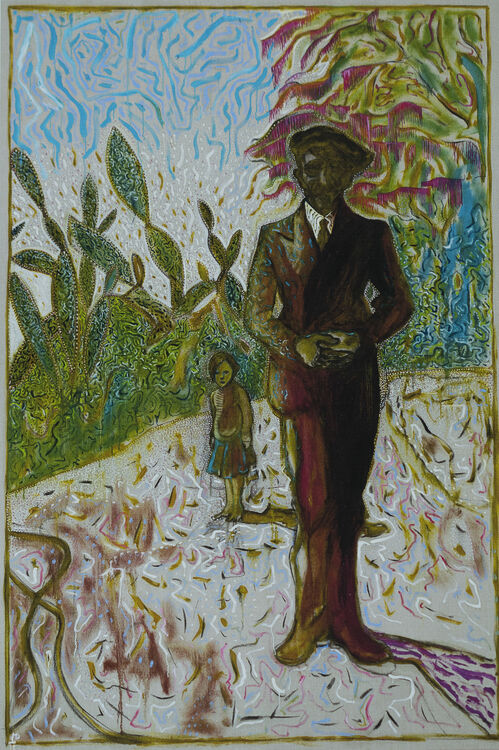
Amongst Cactus, ca. 2014
Billy Childish
Hancock Gallery

Chrysanthemums, ca. 2015
Billy Childish
Hancock Gallery

British artist Billy Childish produced about 600 drawings to gain entry to Saint Martin’s School of Art, only to be expelled shortly after for rebellious behavior. Never one to be boxed in or categorized, Childish still retained one belief: his affinity for Van Gogh. For him, the accessibility and sincerity of Van Gogh’s art are a constant inspiration in his introspective figurative works. “Van Gogh is one of the greatest artists because everyone can get it. It’s totally sincere, and grandma gets it,” he told the New York Times.

A fisherman alone on a boat, a self-portrait with his daughter, or an empty forest: Childish often paints scenes of rural life, evocative of the work Van Gogh completed in Arles. Amongst Cactus (2013), a portrait of Childish and his daughter in the desert, is defined by heavy, erratic lines and kaleidoscopic colors, akin to Van Gogh’s alleged last painting, Tree Roots (1890).

Childish is currently represented by Lehmann Maupin, which presented a solo booth of his paintings at Frieze London 2024.

Matthew Wong

B. 1984, Toronto. D. 2019, Edmonton, Canada.

Starry Night , 2023
Matthew Wong
Mr & Mrs Clark’s

The Realm of Appearance , 2018
Matthew Wong
Mr & Mrs Clark’s

In Canadian artist Matthew Wong’s Starry Night (2019), the late Canadian artist depicted a blue-toned landscape where a lakeside town sits under a star-speckled sky. But instead of Van Gogh’s swirling stars, Wong dotted the sky with a scale-like pattern pierced by bright yellow dots.

Before turning to painting at 29, Wong initially pursued photography, earning his MFA at City University of Hong Kong’s School of Creative Media. He then taught himself through online forums and library books until his work was spotted by Matthew Higgs, founder of New York nonprofit White Columns, on Facebook. Before his tragic suicide in 2019, Wong experienced a meteoric ascent, gaining worldwide recognition for his uncanny, melancholic landscapes and luminous interiors.

Wong often employed sharp contrasts in color—dark skies against florid forests, or dark blue skyscapes speckled by yellow stars. The Realm of Appearances (2018), for instance, where the moon sits above a red-clad forest scene, is typical of Wong’s dense, textured landscapes with energetic markmaking and impasto techniques.

Only a year before his death, Wong presented his New York solo debut with Karma. Three years later, the artist’s first museum retrospective was presented posthumously at the Dallas Museum of Art. In response to his death, American painter Jonas Wooddubbed Wong “the modern-day Van Gogh.”

March Avery

B. 1932, New York. Lives and works in New York.

Wittenberg Parkland, 1966
March Avery
BLUM

The daughter of artists Milton Avery and Sally Michel Avery, March Avery learned how to paint at home, yet not directly from her artist parents. “My father did not teach me. He was a very non-verbal painter,” the artist explained on her website. “I would show him one of my paintings, and all he would say was ‘paint another.’ The only advice I can remember him giving me was not to go to art school—and I didn’t.”

Surrounded by her parents and their friends—Mark Rothko and Marsden Hatley, to name a few—Avery developed into an acute colorist. In Wittenberg Parkland (1966), a landscape of rolling hills beyond a flat plain, the orange and ocher tones of the mountains contrast strikingly with the muted pinks and purples of the flatland. It’s a deceptively simple landscape where surprising color captures light and shadow, mirroring how Van Gogh used yellows and red to depict sunrise in The Red Vineyard (1888).

At 92, Avery still paints daily in her Greenwich Village studio in New York. In July 2024, the artist presented her fourth solo exhibition with BLUM, “Quiet Inside.” This exhibition showcased Avery’s still-life work from the 1960s to 2010s, particularly her depictions of various flowers and vases.


from Artsy News https://ift.tt/VcnmjPe

Most high-net-worth collectors are buying from new dealers, Art Basel and UBS survey reveals. https://ift.tt/Le5FRdS

High-net-worth individuals (HNWIs)—those collectors who spend a minimum of $10,000 on art annually—are more likely to buy work from new art dealers than ever before, according to the Art Basel and UBS Survey of Global Collecting 2024. Specifically, the report found that 88% of collectors have branched out to at least one new gallery over the past year, buying from an average of 17 galleries in 2024, up from 13 in 2019.

Conducted by Dr. Clare McAndrew, founder of Art Economics, in collaboration with UBS, the 2024 survey gathered responses from over 3,660 high-net-worth collectors across 14 markets, including the U.S., the U.K., Mainland China, and Brazil. The study looked into the purchasing habits and motivations of art collectors during 2023 and the beginning of 2024. Over this time period, the art market has seen a challenging landscape, with high interest rates and global tensions on the rise.

The report found that average expenditure by high-net-worth collectors fell by 32% in 2023. However, median spending only slightly decreased from $50,165 in 2022 to $50,000 in 2023. Meanwhile, median expenditures in the first half of 2024 ($24,555) were also stable for this year. This suggests that any shifts in spending may be happening at the highest and lowest ends of the market.

Despite a decline in average spending, collectors are actively exploring new opportunities in the art market, often purchasing from a more comprehensive array of dealers and at more accessible price points. “The HNWIs we surveyed were transacting through a more diverse range of channels and price points in 2023 and 2024, engaging with more galleries than in previous years, including more new galleries,” McAndrew said in a statement. “These changes are likely to contribute to the ongoing shift in focus away from the narrow high-end of sales that has dominated in previous years, potentially expanding the market’s base and encouraging growth in more affordable art segments, which could provide greater stability in future.”

The report also showed that optimism in the art market is on the rise. 91% of high-net-worth collectors feel optimistic about the art market’s performance over the next six months, up from 77% at the end of 2023.

An ongoing theme in the current art market is the impact of intergenerational wealth transfer. A portion of the wealthiest collectors is expected to transfer over $6 trillion in wealth and assets to heirs and charities within the next 20 to 30 years. According to the report, 91% of collectors have acquired an artwork through inheritance or a gift through a will, with 72% keeping at least one of these pieces. So, even though tastes might be shifting, these works are remaining with collectors for now.

Here are some key findings from the report:

  • 95% of collectors surveyed purchased through art dealers, 41% at art fairs, and 67% at auctions in 2024.
  • 72% bought through dealer websites or online viewing rooms, and 43% purchased through Instagram.
  • The share of works by women artists in high-net-worth individuals’ collections reached a seven-year high at 44%.
  • Collectors surveyed allocated 52% of their expenditure to works by new and emerging artists.
  • 70% of gallery purchases made by these collectors were local, up from 50% in 2022.
  • Average spending among millennial high-net-worth collectors dropped by 50% to $395,000 in 2023, while Gen X respondents led spending at $578,000.
  • Collectors in Mainland China reported the highest expenditures, with a median of $97,000 over this period. This figure was more than double that of any other region surveyed.
  • Over 75% of collectors surveyed purchased paintings, 56% bought works on paper, and 35% bought prints in 2023.
  • 43% of collectors planned to purchase art in the next 12 months, a decrease from previous years, when around 50% of those surveyed expressed plans to purchase.


from Artsy News https://ift.tt/UK3tpQb

Latest Post