Friday, February 27, 2026

Rising Painter Freya Douglas-Morris Creates Fantastical Landscapes that Forget the World https://ift.tt/FhiNZfW

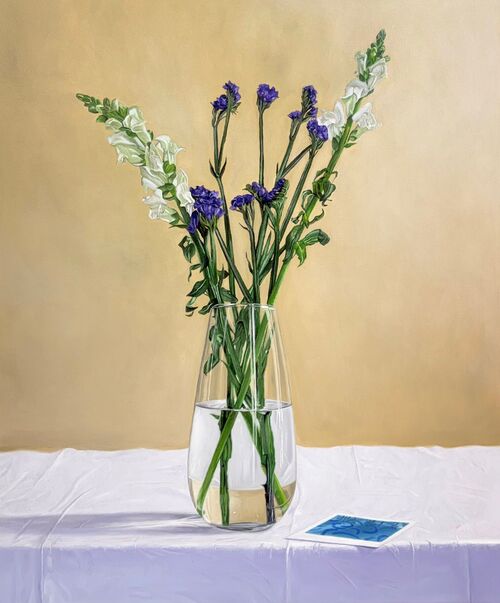
Ribbons of time, 2025
FREYA DOUGLAS-MORRIS
Lehmann Maupin

Freya Douglas-Morris spends most of her time in the studio trying to forget. When she arrives each day at her East London space, she puts on the radio, deletes social media off her phone, and filters out the obligations of daily life. What emerges from this productive erasure are the dreamy, luminous landscape paintings that have garnered so much attention over the past 10 years. “When I come into the studio, I am as much trying to forget as I am to remember,” she explained. “In fact, I probably am trying to forget more than remember.”

Douglas-Morris’s exhibition “My time here is brief,” which inaugurates Lehmann Maupin’s new London gallery space, presents a dozen oil paintings of various sizes from the past 12 months, including the artist’s largest canvas to date. The variation in scale is deliberate. Douglas-Morris has thought carefully about how a viewer will move through the show: how a large canvas creates a sense of peripheral immersion, while a smaller work pulls you into something more intimate. It’s an important sign of her rising profile. Her 2023 solo debut with Alexander Berggruen in New York brought wider attention, and spring 2027 will bring concurrent shows with both galleries in New York.
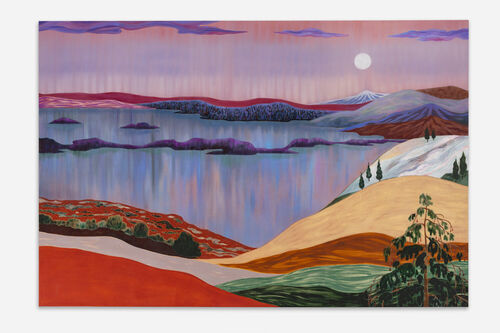
We went on a walk to celebrate, the land stretched on unending, 2026
Freya Douglas-Morris
Lehmann Maupin

Inspired by nature

Her works have the softness of something half-remembered, or perhaps half-forgotten. Though often based on recollections of Douglas-Morris’s walks in nature, the paintings of rolling hills, open vistas, placid lakes, and solitary trees don’t depict specific places or memories. They prioritize internal feeling over geography and are more interested in communal experience of nature than any personal response.

Over the past decade, Douglas-Morris’s practice has evolved from working with photographs to internalized imagery. After graduating from the Royal College of Art in 2013, she spent years refining her approach—including during lockdown, when she painted from a home studio while raising two young children. “It was harder to do the forgetting then,” she recalled. Now her studio is hers alone, a room in a block of artist studios. She keeps formulaic hours: Monday to Friday until she leaves to pick up her children, and no one interrupts her, making it easier to filter out the obligations of daily life.

A new approach to landscapes

The title “My time here is brief” suggests her continued interest in ephemerality: the brevity of human life compared to geological time and nature’s fleeting cycles. The painting Rush of autumn (2026) captures the drama of the season’s changing leaves while Almost morning (2025) depicts the subtler shifts of light in the early hours. Though figures, once a focus of her practice, have disappeared (for now at least), Douglas-Morris doesn’t consider her painted landscapes empty. Human presence is still referenced in titles, such as We went on a walk to celebrate, the land stretched on unending (2025), which hint at context and stories beyond the frame.

“I think landscape is a total narrative,” she said. “It’s just a narrative that doesn’t have the figures in it right in front of you. There are so many histories, so many things that have happened in those places, things that will happen, things that are bigger than you and wider than you.” Although she lives in London, Douglas-Morris finds nature close at hand. She is based in Clapton, five minutes from Hackney Marshes, a green area with elements of wilderness as well as abandoned industrial leftovers from the 20th century.

She often walks along the River Lea, where she cherry-picks elements to include in her paintings, such as weeds and bulrushes. She also has a small garden, and finds herself moved by the grass coming back every year. “I feel grateful to live in a country that has seasons,” she said. “There’s a real beauty in the seasons because of the sense of time passing they give you.”

A surprising use of color

Much of the emotional effect of her work comes from color. Douglas-Morris chooses tones that are unexpected for natural landscapes—aubergine, celadon, tangerine, lavender—and pairs them in combinations that are both surprising and harmonious. Drawing inspiration from the Fauvists, Helen Frankenthaler, and Mark Rothko, she prioritizes emotional resonance over naturalism. “My paintings are more about color than anything else,” she explained. “I could paint the exact same image 10 times in different colors and it would be an entirely different painting. It is so much more about the feeling. The description is secondary.”
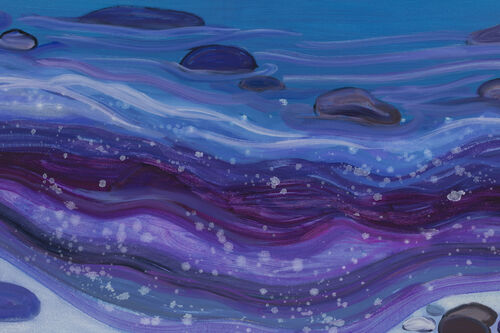
Though her purple skies and luminous moons could feel “almost sugary,” as she put it, she deliberately introduces elements that create tension—dark looming forms that could be rock, cloud, or approaching night; ambiguous weather that might be rain or snow. Douglas-Morris is after an element of surprise, something that makes a viewer pause. She likes conveying this sense of her landscapes as living, shifting places, rather than unchanging vistas.

“I would love the paintings to feel like something more could happen in them. The rain might pass, or someone might walk through, or the moon might set.” By refusing to fix her landscapes in memory or place, Douglas-Morris invites viewers to bring themselves into the painting. It’s a fitting posture for an artist who sees landscape as inherently communal.


from Artsy News https://ift.tt/kmPzj6e

$2.8 million Njideka Akunyili Crosby leads sales at Frieze Los Angeles 2026. https://ift.tt/Mrzwpxk

Frieze Los Angeles 2026—the city’s flagship art fair and a bellwether for the top-end of the West Coast market—opened to VIPs on Thursday, February 26th, at the Santa Monica Airport. The fair’s first hours yielded a slew of major transactions across blue-chip and contemporary galleries, led by David Zwirner’s sale of a mixed-media work by Njideka Akunyili Crosby for $2.8 million.

There was a brisk pace to early sales and strong attendance from prominent collectors, museum leaders, and figures in the entertainment industry, with A-list actors including Emma Watson and Christoph Waltz spotted in the aisles. By late afternoon, blue-chip galleries reported sales from some of their top artists alongside clear demand for emerging artists in the Focus section dedicated to younger galleries.

“There’s been strong attendance today and a good energy. Largely collectors from the U.S., and institutional representatives in town too,” reported dealer Thaddaeus Ropac. “Our presentation has been well received, with sales happening in the first few hours and decisions still being made on other significant works.”

Taking place a year after the Los Angeles fires, the fair carried additional resonance for the city’s cultural community, many of whom are still rebuilding studios, homes, and neighborhoods. Against that backdrop, the strong opening-day sales and visible institutional support signaled not only market confidence but a broader commitment to sustaining Los Angeles’s creative ecosystem.

Here, we round up some of the leading initial sales reported by galleries at Frieze Los Angeles. Check back next week for a full market report from the fair’s run.


from Artsy News https://ift.tt/Gv5dwz0

Thursday, February 26, 2026

5 Artists We Discovered at Felix Art Fair 2026 https://ift.tt/hSwjeVx

Sun-soaked and stylish, Felix Art Fair returned for its eighth edition on February 25, 2026, once again taking over the iconic Hollywood Roosevelt Hotel.

Founded in 2018 by collector and television executive Dean Valentine alongside Al and Mills Morán of local gallery Morán Morán, the fair has become a cornerstone of L.A. Art Week thanks in no small part to its storied setting and sharp eye for tastemaking exhibitors.

Few venues capture old Hollywood glamour quite like the Roosevelt. This year, blessed with warmer-than-expected weather (a welcome reprieve for blizzard-weary New Yorkers), the hotel felt especially inviting. From the David Hockney–designed pool that anchors the fair’s social scene to the guest rooms—replete with rich textures, hardwood floors, and the occasional sliding barn door—Felix balances conviviality with discovery, with artworks tucked inventively into the hotel’s intimate interiors.

And with this year’s edition featuring 57 galleries (more than 20 of which are participating for the first time) there is plenty to unearth. Nearly a third hail from Los Angeles, joined by exhibitors from as far afield as Tokyo and Seoul. That said, artworks across the fair regularly referenced its locale: Many highlighted the iconography and influences of the City of Angels, as well as Hollywood heritage and Californian culture.

Felix is also permeated by a remarkable sense of communality and collective spirit. That ethos was especially palpable at Felix’s 2025 edition, when organizers forged ahead in the wake of devastating fires across the city. Now, with renewed resilience, Felix—and L.A.’s art scene at large—continues to look forward.

Below, we spotlight five artists we discovered in the rooms, cabanas, and even the occasional bathroom at Felix Art Fair 2026.


Maddy Inez

B. 1993, Los Angeles. Lives and works in Los Angeles.

Showing with Megan Mulrooney

Among the greenery on the deck of L.A. gallery Megan Mulrooney’s elegant cabana presentation, a gentle trickle can be heard. Its source is The Sower (2023), a fountain by local artist Maddy Inez. Lurching and biomorphic, the ceramic form seems to rise from the ground itself, its shimmering surface evoking bubbling earth or calcified organic matter. What could sound foreboding instead feels hypnotic: water flows calmly through the sculpture, giving the shaded installation a meditative calm.

Inez is the daughter of Alison Saar and granddaughter of Betye Saar, two major artists who are towering figures in L.A.’s history, and her practice carries that legacy. Working primarily in ceramics, she creates forms that echo plant and animal life, often threading in personal references. Her ongoing series “Memory Jugs,” for instance, pays direct homage to her grandmother Betye’s references to African American folk art tradition. They function as intimate vessels that honor her family histories.


Julien Lischka

B. 1986, France. Lives and works in Paris.

Showing with sobering

Mustang, 2025
Julien Lischka
sobering

Le Bouquet , 2025
Julien Lischka
sobering

At a fair teeming with references to California, some of the sharpest takes on the state come from much farther afield. French painter Julien Lischka, represented by Paris gallery sobering, is “obsessed” with California, according to co-founder Patricia Kishishian—and it shows. In the gallery’s densely hung room, his paintings cut through with a cool precision and emotional weight.

Lischka cites West Coast movies like Michael Mann’s Heat (1995) and Nicolas Winding Refn’s Drive (2011), and his canvases have the visual impact of film stills. In Mustang (2025), a gas station’s red canopy casts a harsh, artificial glow that slices through inky darkness, catching the chrome and curves of the car below. The result is high-contrast images simmering with tension, which wouldn’t look out of place in either film.

Initially trained as a mathematician, Lischka brings a rigorous compositional logic to even his quietest scenes. Le Bouquet (2025), for instance, a meticulously rendered still life of flowers in a glass vase, reveals that same exactitude, with order and atmosphere held in taut balance.


Seo Hyun Kim

B. 1991, South Korea. Lives and works in Seoul.

Showing with Gallery Playlist

Dancing fossil, 2026
Seo Hyun Kim
Gallery Playlist

South Korean artist Seo Hyun Kim makes her U.S. debut with Gallery Playlist, presenting a suite of paintings made with traditional materials and oil paint to evoke geological and historical depth.

Working with pigment and oil on fabric-layered canvas, Kim builds up skin-like surfaces. The embedded fabric creates subtle ridges and valleys that catch the light of the hotel suite, creating a tactile presence. In Dancing Fossil (2026), a mythic, horse-like figure emerges from a swirl of pale pigment that cuts through a murky ground of indigo and charcoal. It’s like a ribbon of smoke, at once animated and frozen.

Kim joins several other rising South Korean artists in the gallery’s presentation, such as Park Yunji and Heejo Kim, who are deftly bridging inherited traditions and contemporary abstraction.


Sacha Ingber

B. 1987, Rio de Janeiro. Lives and works in New York.

Showing with Uffner & Liu

Stolen Document 3, 2022
Sacha Ingber
Uffner & Liu

Part painting, part ceramic, part architectural fragment, Stolen Document 3 (2022), on view at Felix 2026, distills Brazilian artist Sacha Ingber’s ongoing exploration of bureaucracy and craft.

The work consists of two irregular fragments of glazed ceramic mounted inside a thick, curving cast frame with a red inner edge. They’re presented like archaeological fragments, with sections of cane webbing—more commonly found in chair seats or backs—filling parts of the ceramic.

The wall sculpture belongs to a larger body of work inspired by a visit to the Victoria & Albert Museum, according to Uffner & Liu director Lucy Liu. There, Ingber began reflecting on how, as children, we are trained to see and organize the world in grids. Across the surface of the ceramic, loose, gestural marks echo the rhythm of handwriting without yielding legible information. At the same time, green-blue inkjet-transferred grids and administrative symbols impose a sense of rigid formatting. This tension between improvisation and order animates the work: it’s surprising, fragile, and beautiful.

Ingber, who previously exhibited with the gallery under its former name, Rachel Uffner Gallery, will mount a solo presentation at the gallery next month.


Keisuke Tada

B. 1986, Aichi, Japan. Lives and works in Aichi, Japan.

Showing with Chilli Gallery and Slip House

Painting of Incomplete Remains #302, 2025
Keisuke Tada
Chilli Gallery

Painting of Incomplete Remains #306, 2025
Keisuke Tada
Chilli Gallery

Deeply researched and painstakingly rendered, Keisuke Tada’s paintings can take up to two years to complete. At the shared booth of London’s Chilli Gallery and New York’s Slip House, the Japanese artist presents a series of fictional historical landscapes built from as many as 20 layers of acrylic and modeling paste. The dense surfaces convincingly mimic weighty materials such as rusted chains or wooden doors before being subjected to an artificial aging process. Through chemical reactions and physical force, Tada cracks, peels, and distresses the paint, giving the impression of a relic from an imagined past.

Up close, the works resemble 19th-century landscapes or Dutch still lifes salvaged from a damp basement after two centuries. Paint flakes and curls; entire passages appear to have fallen away. Yet the exposed “wood” beneath is itself meticulously painted. “Everything you see is hand-painted, and it has this very digital feel—it’s kind of uncanny,” said Chilli director Aubrey Higgin.

That play between reality and fiction lies at the heart of Tada’s practice. Having previously exhibited with Tokyo galleries, including Gallery Common, the artist made his New York debut late last year with Slip House.


from Artsy News https://ift.tt/HIbOkin

David Hockney's first English landscape painting to go on sale at Sotheby's. https://ift.tt/gNn0Hyw

English Garden (1965), the first English landscape David Hockney ever painted, is headed for auction. The work will be included in Sotheby’s modern and contemporary evening auction in London on March 4th. It is estimated to fetch between £2.5 million and £3.5 million ($3.38 million–$4.73 million). Ahead of the sale, the work will be on display for the first time in three decades in Sotheby’s London galleries. English Garden marks a pivotal moment in Hockney’s career; rigorous explorations of natural scenes came to define his work. The artist painted the tableau from memory while living in Boulder, Colorado. “English Garden was also painted in Boulder from a photograph of topiary work in England that I found in American Vogue,” the artist wrote in his 1988 book, David Hockney by David Hockney. “As it was painted at the same time as Rocky Mountains and Tired Indians (1965), some students thought it was a picture of Indians squatting on a lawn.” It was painted at a time when abstract art dominated the market, and Hockney’s portrayal added new depth to the landscape genre. The last time the work was publicly seen was in 1997, when it was sold at a previous Sotheby’s auction and entered a private collection.

Other sale highlights include a series of works by School of London artists, ranging from a 1972 self-portrait painted by Francis Bacon following a personal tragedy (estimated £8 million–£12 million; $10.8 million–$16.2 million) to a pair of career-defining portraits, A Young Painter (1958) (estimated £4 million–£6 million; $5.41 million–$8.11 million) and Blond Girl on a Bed (1987) (estimated £6 million–£8 million; $8.11 million–$10.8 million) by Lucian Freud. Leon Kossoff’s Children’s Swimming Pool (1971) (estimated £600,000–£800,000; $811,000–$1.08 million), which is considered to be the British figurative painter’s masterpiece, is also on offer.

Meanwhile, a suite of Impressionist and Modernist works by Claude Monet, Paul Signac, Fernand Léger, and Edgar Degas are also for sale, their estimates ranging from £2.5 million–£3.5 million ($3.38 million–$4.73 million) for Degas’s Scène de ballet (c. 1885) to £6.5 million–£8.5 million ($8.79 million–$11.49 million) for Monet’s 1884 oil on canvas Maison de jardinier, which he painted while in Italy.

Other works by major British painters round out the sale. They include a monumental sculpture by Barbara Hepworth, a large-scale example of Briget Riley’s curve paintings, and Glenn Brown’s only self-portrait.


from Artsy News https://ift.tt/Kg8ApvZ

Hungarian conceptual artist Dóra Maurer dies at 88. https://ift.tt/J1V892z

Seven Rotations 1 – 6, 1979
Dóra Maurer
Whitechapel Gallery

Dóra Maurer, a multimedia artist who was a monumental figure of the Hungarian art scene, died on February 14th at the age of 88. Her death was confirmed by the the Széchenyi Academy of Literature and Art in Budapest, where she had served as president since 2017.

The artist’s work spans painting, printmaking, film, sculpture, photography, performance, and collage. She was fascinated by motion, and the way that forms are transformed by time and space. Over the course of her more than 50-year career, she produced experimental work using geometry and color theory that was grounded in playful investigation. “My whole way of thinking comes less from painting; my approach is much more influenced by my long years of conceptual and conceptional activity,” the artist once said of her work, according to a text published by White Cube, which represented the artist along with Carl Kostyál.

Maurer was born in Budapest in 1937. She studied painting and graphic arts at the Hungarian Academy of Fine Arts during the Hungarian revolution. She graduated in 1961 and began working as a printmaker, before expanding her practice to include painting and photography towards the end of the 1960s. Her marriage to Austrian artist Tibor Gáyor in 1967 allowed her the opportunity to travel between Budapest and Vienna, which gave her a unique perspective on both sides of the Iron Curtain that was reflected in her work.

The 1970s were her most productive decade, producing some of her best-known works including Quasi-images (1970–73), Seven Twists (1979), and her Reversible and Changeable Phases of Movement (1970s) series. Color began to show up in her work in the 1980s as the communist regime imposed less control over artists, and in 1990 she began teaching at the Hungarian Academy of Fine Arts. During this time she traveled back and forth between Hungary and Austria, sometimes smuggling other Hungarian artists’ work with her.

While she had been a star in her native Hungary since the 1970s, she only received greater international acclaim later in life. Curators Jens Hoffman and Adriano Pedrosa included a selection of her 1979 Seven Rotations dizzying self portraits in the 2011 Istanbul Biennale, which led to group shows at New York’s Museum of Modern Art, the Centre Pompidou in Paris, and the Museum of Fine Arts, Houston. Prominent solo shows have been held at the Tate Modern in 2019, and the Museum Ritter in 2014. Her work is held in prominent collections including The Metropolitan Museum of Art, the Art Institute of Chicago, and the Neue Nationalgalerie. In 2021 she was awarded the Artist of the Nation award, a Hungarian state honor for cultural achievements.


from Artsy News https://ift.tt/FcbU1RQ

Wednesday, February 25, 2026

Venice Biennale 2026 announces list of 111 artists participating in main exhibition. https://ift.tt/dBFQlqr

The 2026 Venice Biennale’s main exhibition, “In Minor Keys,” will include 111 artists, the organizers announced today. The exhibition, curated by the late Koyo Kouoh, will go on as planned following the curator’s untimely death from cancer at the age of 57 in May of last year. The biennale will run from May 9th through November 22nd, with pre-openings on May 6th, 7th, and 8th. The awards ceremony will be held on May 9th.

Among the 111 artists included, 105 are individual artists and 6 are artist-led organizations. This is far fewer than the 330 artists that were included in the 2024 Venice Biennale, which was curated by Adriano Pedrosa. Notably, there is a broad geographical focus among this year’s participating artists, many of whom hail from the Global South. There is also a strong uptick in living artists (both the 2024 and 2022 editions included many artists who were deceased).

The oldest living artist who will show in the exhibition, Mmakgabo Mmapula Helen Sebidi, was born in 1943, while the youngest, Mohammed Z. Rahman, was born in 1997. Other artists invited to exhibit in the show include Otobong Nkanga, Torkwase Dyson, Wangechi Mutu, Alvaro Barrington, and Tuấn Andrew Nguyễn. Australian artist Khaled Sabsabi, who will be presenting work at the Australian pavilion following a turbulent selection process, is also included in the main show.

Following Kouoh’s death, the Biennale confirmed that the curator had already begun selecting artists, considering commissions, and building out programming. She had also devised the main theme for the show. However, there will be no Golden Lion lifetime achievement awards presented at this year’s Biennale, as Kouoh did not have time to select them. As previously reported, the curator’s plans for the exhibition will be realized by her team, including advisors Gabe Beckhurst Feijoo, Marie Hélène Pereira and Rasha Salti, Siddhartha Mitter, and research assistant Rory Tsapayi.

“The pages of In Minor Keys, which Koyo sent to La Biennale almost a year ago, offer a striking insight into her curatorial practice and spell out a crystal-clear notion of her own concept of an exhibition,” said Biennale president Pietrangelo Buttafuoco in a statement. “It is an exhibition permeated with spirit, with a sacredness that puts the person, the human being, back at the heart of things, rediscovering the sense of being in the world by reacquiring a sense of proportion with respect to all earthly elements, and by looking to the sky once more.”

The show will be organized around motifs including “Shrines,” “Procession,” “Schools,” “Rest,” and “Performances”. “Shrines” in the Sala Chini, for instance, will be presented as a dual tribute to artist and poet Issa Samb and Beverly Buchanan, who worked across painting, sculpture, video, and land art.

The works under the “Procession” motif, meanwhile, draw inspiration from the act of engaging with a crowd rather than simply observing, like at carnival festivities or Afro-Atlantic gatherings. These include works by Big Chief Demond Melancon, Nick Cave, and Ebony G. Patterson (who was featured in the Artsy Vanguard 2019).

Elsewhere, Kouoh devised the “Schools” theme to give space to art institutions that have been pivotal in shaping artists,. “Rest” will present works by Linda Goode Bryant, Kennedy Yanko, and Annalee Davis to provide moments of contemplation and pause through multisensory installations and spaces. In addition, a program of performances, including one inspired by Kouoh’s 1999 performance Poetry Caravan, will take place in the Giardini.

The full list of artists participating in the 2026 Venice Biennale main exhibition can be found here.


from Artsy News https://ift.tt/G3yKvPz

Tuesday, February 24, 2026

Major Lee Krasner and Jackson Pollock show to open at the Met. https://ift.tt/aVUhC2x

The Metropolitan Museum of Art in New York has announced a two-person show featuring major artists Lee Krasner and Jackson Pollock. The exhibition, titled “Krasner and Pollock: Past Continuous,” will be on view from October 4th, 2026 through January 31st, 2027. It brings together more than 120 paintings, works on paper, and ephemera from over 80 collections.

The comprehensive exhibition will cover the entire careers of the two Abstract Expressionist artists, who were peers and life partners, and trace the parallels between their practices. The show will mark the first time in over two decades that either artist has been the subject of a major show in New York.

The Eye is the First Circle, 1960
Lee Krasner
Royal Academy of Arts

“By considering each artist on their own terms while also foregrounding their consequential relationship, the exhibition situates Krasner's and Pollock's work within a broader cultural and artistic context,” said The Met’s director, Max Hollein, in a statement. “This project affirms Krasner and Pollock not only as defining figures of their moment, but as artists whose work continues to shape and inspire future generations.”

As distinct as their practices were, Krasner and Pollock also had an immense influence on each other’s work. They met as young artists when they were both included in an exhibition organized by the American painter John Graham in 1942, and married in 1945. Pollock soon shot to fame with his drip paintings which employed novel uses of paint on canvas, though his career was cut short by an untimely death in 1956. Krasner was known for her own approach to painting, in which the artist collaged paper and canvas from her previous works to form new compositions. Though she maintained her practice over the course of nearly six decades, she was largely overshadowed by Pollock—in 1949, LIFE Magazine asked if he was “the greatest living painter in the United States.” Recent dialogues have reconsidered the imbalance, and with the forthcoming exhibition, The Met seeks to course correct the narrative.

“‘Krasner and Pollock: Past Continuous’ begins with the fundamental premise that these artists are equals, partners in life, giants in the history of art, and revolutionaries who defined what abstraction could be,” said David Breslin, The Met’s curator in charge of the department of modern and contemporary art, in a statement. “Each found a partner who would insist on the primacy of art over life; and they both aspired to an art that was forged out of historical connections but that also promised freedom and radical possibility in a world forever changed by war. The exhibition concerns entwined lives but is also about how different artistic directions come from shared terrain.”

The show will be organized into twelve chapters, with some galleries dedicated to each artist individually, and others placing their work in dialogue. Highlights include Krasner’s Composition (1949), The Eye is the First Circle (1960), and Combat (1965), and Pollock’s Stenographic Figure (1942), Number 1, 1950 (Lavender Mist) (1950), and The Deep (1953). The show will feature rarely-seen works from private collections, as well as pieces on loan from institutions including the Museum of Modern Art (MoMA), the Whitney Museum of American Art, and the Centre Pompidou.


from Artsy News https://ift.tt/t4jPWnC

Latest Post